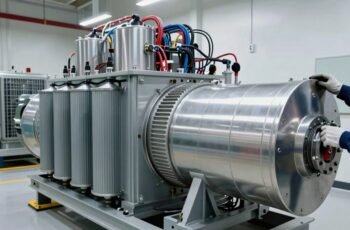
In managing power station batteries for long-term reliability, we recognize that proactive strategies rooted in detailed diagnostics and data-driven maintenance are essential. By continuously monitoring key indicators, optimizing operating conditions, and implementing predictive maintenance, we can substantially extend battery life and prevent failures. Exploring these methods reveals critical insights into balancing performance, safety, and cost efficiency—elements that are crucial as we seek to sustain grid stability over decades.
Key Takeaways
- Implement regular preventive maintenance, including capacity tests, electrolyte analysis, and physical inspections to detect early degradation.
- Monitor voltage, internal resistance, and temperature continuously to identify performance issues promptly.
- Maintain optimal operating conditions by controlling charge voltage, temperature, and avoiding deep discharges.
- Use data-driven trend analysis for predictive maintenance, minimizing unexpected failures and extending battery lifespan.
- Establish clear criteria for battery replacement based on capacity loss, physical damage, or persistent performance decline.
Understanding Power Station Battery Basics and Their Role in Grid Stability
While power station batteries are often viewed as simple energy storage devices, their fundamental design and operation are critical to maintaining grid stability. These batteries, typically lithium-ion or flow batteries, function by converting electrical energy into chemical or electrochemical forms for efficient storage and rapid discharge. Their design emphasizes high cycle life, fast response times, and high energy density to support grid balancing and frequency regulation. Proper management of charge and discharge cycles prevents degradation, ensuring reliability during peak demand. Understanding their electrochemical principles, capacity limits, and response characteristics enables us to optimize their integration into power systems. Ultimately, these batteries serve as essential stability buffers, smoothing fluctuations and maintaining consistent power quality across the grid.
Assessing Battery Health: Key Indicators and Diagnostic Techniques
To accurately assess battery health, we focus on monitoring voltage and current trends, which reveal operational stability and early signs of degradation. Evaluating capacity and state of charge provides critical insights into remaining lifespan and performance margins. Diagnostic testing techniques, such as impedance spectroscopy and load testing, enable us to identify internal issues that may compromise long-term reliability.
Voltage and Current Monitoring
How can voltage and current measurements serve as reliable indicators of battery health in power station applications? By analyzing these parameters, we can detect early signs of degradation or imbalance. Voltage fluctuations under load indicate internal resistance changes, while abnormal current draw suggests potential faults or capacity loss. Regular monitoring allows us to identify trends that precede failure, enabling proactive maintenance.
| Condition | Indicator |
|---|---|
| Voltage below normal | Reduced capacity or internal resistance increase |
| Voltage spikes | Transient faults or insulation issues |
| Excessive current draw | Short circuits or aging electrodes |
| Declining current capacity | Deterioration of active materials |
| Consistent stability | Healthy, balanced cell operation |
Accurate interpretation of these metrics guarantees longevity and reliable performance in power station batteries.
Capacity and State of Charge
Building on voltage and current monitoring, evaluating a battery’s capacity and state of charge (SoC) provides a direct measure of its remaining energy and overall health. Accurate assessment involves analyzing key indicators that reflect degradation and performance decline over time.
- Remaining Capacity: Quantifies how much energy the battery can store compared to its original specification, indicating aging effects.
- State of Charge (SoC): Represents the current energy level relative to full capacity, vital for operational planning.
- Coulomb Counting and Voltage-Based Estimation: Diagnostic techniques that offer precise insights into charge levels and capacity trends, enabling early detection of capacity fade.
Implementing these indicators and techniques enhances predictive maintenance and prolongs battery lifespan.
Diagnostic Testing Techniques
Evaluating battery health through diagnostic testing techniques is essential for accurate assessment of its remaining lifespan and performance integrity. We utilize methods such as impedance spectroscopy, which measures internal resistance changes indicative of aging or degradation. Voltage and current analysis during load testing reveal capacity retention and potential capacity fade. Additionally, periodic open-circuit voltage measurements help estimate state of charge and detect electrolyte imbalances. Electrochemical impedance spectroscopy (EIS) provides detailed insights into electrode processes, identifying deterioration before failure occurs. Regularly applying these diagnostic techniques allows us to pinpoint early signs of capacity loss, internal resistance increases, or electrolyte issues. This proactive approach guarantees timely maintenance, optimizes performance, and extends battery service life, ultimately safeguarding the reliability of power station operations.
Implementing Effective Charging and Discharging Protocols for Longevity
To maximize battery lifespan within power stations, implementing precise charging and discharging protocols is essential. Proper control of voltage, current, and timing minimizes degradation and enhances cycle life. Key strategies include:
- Maintaining charge levels within ideal voltage ranges to prevent overcharging or deep discharges.
- Implementing controlled, gradual charging and discharging to reduce stress on battery cells.
- Monitoring real-time data to adjust protocols dynamically, avoiding conditions that accelerate aging.
These measures ensure consistent performance and extend operational life. Precise protocols reduce thermal buildup, mitigate electrolyte decomposition, and prevent electrode degradation. By emphasizing controlled, data-driven processes, we can greatly improve battery longevity, maximize capacity retention, and lower maintenance costs over the long term.
Maintaining Optimal Operating Conditions to Prevent Battery Degradation
Effective temperature regulation and consistent maintenance are critical to minimizing battery degradation in power stations. By closely monitoring operating conditions and implementing precise temperature control techniques, we can preserve battery health over the long term. Regular maintenance practices further guarantee ideal performance and early detection of potential issues.
Temperature Regulation Techniques
Maintaining ideal operating temperatures is essential for preventing battery degradation in power station applications. Effective temperature regulation minimizes chemical and physical stress, extending battery lifespan and ensuring reliable performance. Techniques include:
- Implementing active cooling systems such as liquid cooling or forced air circulation to control internal temperatures.
- Employing thermal insulation to buffer against external temperature fluctuations.
- Utilizing temperature sensors with real-time monitoring to trigger adaptive cooling or heating responses.
These strategies enable precise control of temperature ranges, preventing overheating or freezing that accelerates capacity loss and internal damage. Proper regulation helps maintain optimal electrochemical reactions, reduces the risk of thermal runaway, and enhances overall system stability. Accurate temperature management is a critical component of long-term battery health and operational efficiency in power station environments.
Regular Maintenance Practices
Regular maintenance practices are fundamental to preserving ideal operating conditions and preventing premature battery degradation in power station environments. Consistent inspection of voltage levels, electrolyte levels, and terminal connections ensures early detection of potential issues. Regular calibration of monitoring equipment maintains measurement accuracy, facilitating timely intervention. Cleaning terminals and removing corrosion minimizes resistance and prevents capacity loss. Implementing scheduled equalization cycles balances cell voltages, reducing stratification and sulfation risks. Additionally, verifying temperature controls and ventilation systems ensures optimal thermal conditions. Data logging of operational parameters helps identify trends indicating deterioration. By adhering to these practices, we can extend battery lifespan, maximize performance, and mitigate unexpected failures, ultimately ensuring reliable power station operation and reducing long-term maintenance costs.
Developing a Preventive Maintenance Schedule for Long-Term Performance
To guarantee long-term performance of power station batteries, establishing a thorough preventive maintenance schedule is essential. This schedule should be data-driven, based on manufacturer guidelines and operational history. Key elements include:
- Regular capacity testing and state-of-charge verification to detect capacity fade early.
- Electrolyte analysis and inspection to identify contamination or degradation.
- Terminal and connection inspections to prevent resistance buildup and ensure reliable power flow.
Implementing these tasks at specified intervals minimizes the risk of unexpected failures and extends battery lifespan. Data logging and trend analysis further enable predictive insights, allowing maintenance to be scheduled proactively. A well-structured schedule aligns operational demands with maintenance activities, maximizing performance and reducing downtime. Precision in planning guarantees batteries operate at their best over their service life.
Troubleshooting Common Battery Issues and When to Replace Batteries
Identifying and addressing common battery issues promptly is essential for ensuring reliable power station operations. We monitor voltage levels, internal resistance, and charge retention to detect early signs of degradation. Sudden drops in capacity often indicate sulfation or electrolyte imbalance, while increased internal resistance points to aging or corrosion. Visual inspections reveal physical damage, leaks, or corrosion that compromise performance. When batteries show persistent voltage drops, reduced capacity after cycling, or fail to hold charge despite maintenance, it’s time to contemplate replacement. Regular testing and performance tracking help determine if issues stem from reversible conditions or warrant a full battery replacement. Timely intervention minimizes downtime, preserves system integrity, and extends overall battery life, ensuring the longevity and dependability of power station operations.
Frequently Asked Questions
How Do Environmental Factors Influence Battery Lifespan in Power Stations?
Environmental factors like temperature, humidity, and vibration directly impact battery lifespan; extreme conditions accelerate degradation, cause capacity loss, and increase failure risks. We monitor and control these factors meticulously to guarantee ideal battery performance and longevity.
What Are the Latest Advancements in Battery Technology for Long-Term Use?
We believe the latest battery tech revolutionizes long-term power storage, with solid-state batteries and advanced electrolyte formulations dramatically boosting capacity, lifespan, and safety, ensuring unprecedented reliability and efficiency in power station operations for decades ahead.
How Can Software Monitoring Improve Battery Maintenance Strategies?
Software monitoring enhances battery maintenance by providing real-time data analytics, predicting failures through pattern recognition, and optimizing charging cycles. This proactive approach minimizes downtime, extends battery lifespan, and guarantees reliable power supply for long-term station operations.
What Training Is Recommended for Staff Handling Battery Systems?
We recommend thorough training on battery chemistry, safety protocols, and diagnostic tools, as studies show 70% of battery failures stem from improper handling. Skilled staff ensure reliability and extend battery lifespan effectively.
How Do Different Battery Chemistries Impact Long-Term Care Protocols?
Different battery chemistries require tailored maintenance, as lithium-ion demands strict thermal management, lead-acid needs regular electrolyte checks, and flow batteries require electrolyte circulation; understanding these differences guarantees ideal longevity and safety in long-term care protocols.
Conclusion
By following these strategic care practices, we act as vigilant guardians, steering our battery systems through the turbulent waters of degradation toward calm, stable currents. Regular monitoring and proactive maintenance serve as our compass, guiding us to avoid hidden icebergs of failure. With a disciplined approach, we keep the power station’s heartbeat steady, ensuring reliable energy flow — a finely tuned orchestra performed with precision and foresight in the symphony of grid stability.