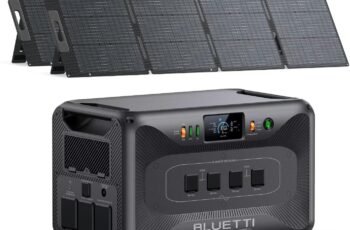
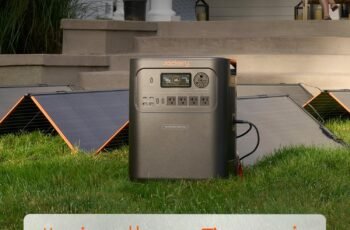
We’ll assess the PowerMax 1800SE by comparing its 1,024Wh LiFePO₄ capacity and 1,800W continuous output with the demands of camping, DIY work, and home backup. Its combined AC and solar charging can reach 80% in 45 minutes, while 11 outlets and a sub-10-millisecond UPS transfer time add practical flexibility. At 36 pounds, it’s less convenient to carry over distance, and its capacity has limits. We’ll examine where its speed and features make the strongest case.
Key Takeaways
- The PowerMax 1800SE delivers 1,800W continuous output, 3,600W surge capacity, and 1,024Wh of LiFePO₄ battery capacity.
- It charges from a wall outlet in about an hour, or reaches 80% in 45 minutes with combined AC and solar input.
- Its 11 outlets include three AC outlets, two 100W USB-C ports, USB-A ports, DC ports, and a car outlet.
- At 36 lb, it’s relatively compact for its capacity but may be awkward to carry long distances.
- It suits home backup, camping, RV travel, and DIY projects; consider runtime needs, solar-panel costs, and the 10ms UPS transfer time.
Rapid 45-Minute Charging
With combined AC and solar input, the PowerMax 1800SE charges from 0% to 80% in 45 minutes. This Charging Speed compares favorably with its single-source options: AC charging takes about one hour for a full charge, while 800W solar input takes approximately 1.5 hours. The station accepts up to 800W from each source, enabling a combined input of 1,600W. For you, Input Flexibility means choosing wall power, compatible solar panels, a car outlet, or a generator according to availability. Solar panels aren’t included, so you’ll need to provide them for solar charging. Actual results may vary with input conditions.
Detailed features
Beyond its charging speed, the PowerMax 1800SE combines 1,800W of continuous output, 3,600W surge capacity, and a 1,024Wh LiFePO₄ battery in a 36 lb unit measuring 16 × 9 × 10 inches. We can compare its ports and controls with its power specifications:
| Feature | Configuration | Function |
|---|---|---|
| AC | Three pure sine wave outlets | 110V output |
| USB | Two 100W USB-C; two USB-A | Device charging |
| DC | Two DC5521; one car port | Vehicle accessories |
Its outlet configuration totals 11 outlets. Bluetooth app connectivity lets us monitor input, output, and battery status, then switch outlets remotely. A UPS function transfers power within 10 milliseconds during outages.
Pros and Cons
We’ll compare the PowerMax 1800SE’s strengths, including its fast charging and long-life LiFePO₄ battery, with its limitations. Its 1,800W output and 1,024Wh capacity suit many devices, but they won’t meet every high-load or extended-power need. Let’s assess which trade-offs matter most for your use.
Pros
The PowerMax 1800SE’s strongest advantages are its 1,024Wh LiFePO₄ battery, fast charging, and broad device support. Its 1,800W output and 3,600W surge rating let us run appliances and tools that smaller stations may not handle. We can charge it from AC, solar, a car outlet, or a generator; combined AC and solar input reaches 80% in 45 minutes. Eleven outlets and app-based monitoring add practical control. The Compact design weighs 36 pounds and occupies less space than comparable-capacity traditional stations. With versatile uses spanning home backup, camping, RV travel, and DIY work, it offers flexible power in one unit.
Cons
Despite its strong output and charging flexibility, the PowerMax 1800SE has trade-offs: at 36 lb, it may be cumbersome to carry over long distances, and its 1,024Wh capacity limits how long it can run high-draw appliances. We’d weigh these limits against its fast charging and broad port selection.
| Consideration | Practical effect |
|---|---|
| Heavy 36 Pound Weight | Less convenient for frequent carrying |
| 1,024Wh capacity | Limits runtime for high-draw loads |
| Limited Solar Availability | Panels aren’t included |
| 800W solar input | Requires compatible panels |
For longer off-grid stays, we’d compare its capacity and solar setup with larger kits. Its 36 lb weight is lighter than some comparable stations, but still substantial for extended hikes.
Concluding thoughts
For users who need substantial output in a portable package, the PowerMax 1800SE balances 1,800W of power and 1,024Wh of capacity with a 36-pound weight. We see it as a strong choice for outages, RV trips, and projects requiring several device types, especially with 11 outlets and a 10-millisecond UPS switch. Its LiFePO₄ battery, five-year warranty, and rapid AC charging compare favorably with many portable stations. However, buyers should weigh runtime needs, the 3,600W surge limit, and the extra cost of solar panels. The ideal user values capacity and portability; key buying considerations include weight, charging access, and required output.
Frequently Asked Questions
What Devices Can the Powermax 1800SE Run?
We can run compatible devices drawing up to 1,800W, including refrigerators, coffee makers, space heaters, grinders, computers, and CPAP machines. It supports running small kitchen appliances and powering camping electronics, provided their combined demand stays within limits.
How Much Does the Powermax 1800SE Weigh?
The PowerMax 1800SE weighs 36 pounds. For PowerMax 1800SE portability, we’d compare that weight with similarly capable power stations: it’s 25% lighter and more compact, though lifting considerations still matter for frequent carrying.
Does the Powermax 1800SE Include Solar Panels?
No, we don’t receive solar panels in the package; they’re sold separately. Solar panel compatibility supports up to 800W input, while solar charging speed reaches about 1.5 hours with an 800W panel, versus roughly one hour using AC.
Can I Control the Power Station Using a Smartphone App?
Yes, we can control the station through its Bluetooth smartphone app. Smartphone app compatibility lets us monitor battery status and input/output power, then remotely switch outlets on or off; no dongle is required for Remote power monitoring.
What Accessories Come in the Box?
We get the PowerMax 1800SE, AC charging cable, solar charging cable, car charger, and user manual in the box. Included charging cables cover AC and solar charging; unlike some kits, no Protective carrying case or solar panels are included.
Conclusion
The PowerMax 1800SE makes waiting for power feel almost quaint: combined AC and solar charging can reach 80% in 45 minutes, though you’ll need to buy the panels separately. Its 1,024Wh LiFePO₄ battery, 1,800W output, and sub-10ms UPS transfer offer more capability than many portable stations, but 36 pounds isn’t featherweight. We’d choose it for fast-charging backup and weekend projects, not prolonged off-grid use. Its speed is impressive; its capacity still sets the limits.