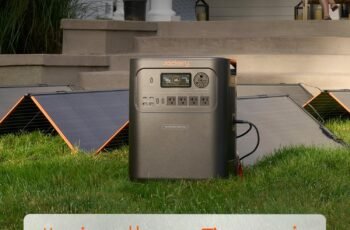
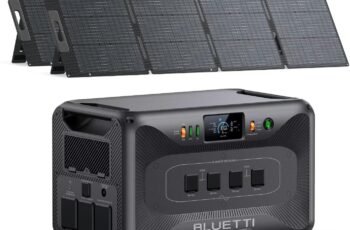
When the lights go out, power matters most—and that’s where the AP1000 makes its case. We get a 1,024Wh LiFePO4 battery, 1,800W pure sine wave output, and 11 outlets in a unit weighing under 30 pounds. Its 45-minute charge to 80% and sub-20ms UPS switching look practical, but capacity and solar performance may limit longer use. Let’s examine how it balances speed, durability, and real-world runtime.
Key Takeaways
- The AP1000 pairs a 1,024Wh LiFePO4 battery with 1,800W continuous pure sine wave output and 3,600W peak capacity.
- HyperFlash AC charging reaches 80% in about 45 minutes and a full charge in roughly an hour; results vary.
- It has 11 outlets, sub-20ms UPS switching, and weighs under 30 pounds for home backup, RVs, and camping.
- The battery is rated for more than 4,000 charge cycles while retaining up to 70% capacity.
- Its capacity limits runtime for high-draw appliances, and the included 100W solar panel recharges slowly in variable sunlight.
45-Minute 80% Charging
When time is limited, HyperFlash AC charging brings the AP1000 to 80% capacity in about 45 minutes and a full charge in roughly 60 minutes. This charging speed can shorten downtime between uses, helping us restore capacity before a trip or during a brief break in home backup. The stated times describe AC charging; actual results may vary with conditions. Once charged, the 1024Wh battery supports power delivery through the station’s 1800W pure sine wave AC output, with 3600W peak output. We can also recharge through a compatible solar panel or vehicle, and supported modes allow AC and solar charging together for added flexibility.
Detailed features
Beyond its fast charging, the AP1000 combines a 1,024Wh LiFePO4 battery with 1,800W of pure sine wave AC output and 3,600W peak output at 110V. We can use its 11 outlet connectivity to run devices such as refrigerators, laptops, routers, lights, and CPAP machines. The battery supports more than 4,000 charge cycles while retaining up to 70% capacity, defining its LiFePO4 lifespan. For recharging, we can connect an AC outlet, compatible solar panel, or vehicle; supported modes also allow AC and solar input together. A sub-20ms UPS transfer helps maintain power to sensitive electronics during interruptions.
Pros and Cons
We’ll weigh the AP1000’s 1,800W output, 1,024Wh LiFePO4 battery, fast charging, and sub-20ms UPS switching against its practical limitations. We’ll also consider its portability and included 100W solar panel. This comparison will help you judge whether its strengths fit your backup or travel needs.
Pros
The AP1000’s strongest advantages are its 1,800W pure sine wave output, fast recharge, and long-life LiFePO4 battery. With 3,600W peak output and 1,024Wh capacity, it can run essentials such as refrigerators, routers, CPAP devices, and lights. We can use its versatile outlets to power multiple devices, while UPS switching under 20ms helps protect sensitive electronics during outages. HyperFlash AC charging reaches 80% in 45 minutes and full charge in about an hour. The battery supports over 4,000 cycles before retaining up to 70% capacity. Under 30 pounds, it’s practical portable backup for home, RV, and campsite use.
Cons
Although the AP1000 recharges quickly, its 1,024Wh capacity limits how long it can run high-draw appliances, and its 1,800W continuous output won’t support devices that exceed that load. We should also account for startup surges, which can approach its 3,600W peak ceiling. Solar limitations matter: the included 100W panel may take considerable time to refill the battery, especially in variable sunlight, and it ships separately. Although its LiFePO4 cells are rated for 4,000-plus cycles, Battery replacement may eventually add cost; the available information doesn’t specify replacement procedures or pricing. At under 30 pounds, it’s portable, but not effortless to carry far.
Concluding thoughts
For users who need portable backup without a gas engine, the AP1000 combines 1,800W of pure sine wave output, a 1,024Wh LiFePO4 battery, and UPS switching under 20ms in a unit weighing under 30 lb. We find its 3,600W peak capacity, 11 outlets, and quiet operation useful for essential appliances, electronics, camping, and RV travel. HyperFlash charging reaches 80% in 45 minutes, while the battery’s 4,000-plus-cycle rating supports Everyday usability and long term value. The included 100W panel adds renewable charging, though its output depends on sunlight. We’d choose the AP1000 when portability, fast charging, and dependable backup matter most.
Frequently Asked Questions
Can the AP1000 Power a Refrigerator During an Extended Outage?
Yes, we can run a refrigerator during an extended outage, but runtime depends on its energy use and recharging. The 1,024Wh battery supplies 1,800W; check Refrigerator runtime estimates and compressor startup demands before connecting.
Is the AP1000 Permitted on Airplanes?
No—the AP1000’s 1,024Wh lithium battery exceeds typical airline limits, so we can’t bring it aboard. Airline battery regulations prohibit it in checked baggage; checked baggage restrictions also bar spare lithium batteries. Contact your airline for confirmation.
Can It Charge Devices While Recharging Itself?
Yes, we can recharge the AP1000 while powering devices, enabling simultaneous device charging. This pass through charging supports connected equipment during AC or solar input, though combined AC-and-solar operation depends on the supported charging mode.
Does the Power Station Support Battery Expansion?
We can’t confirm battery expansion support: the provided specifications list no compatible add-on batteries or expansion limits. The 1,024Wh built-in LiFePO4 battery supports over 4,000 cycles; verify battery compatibility with the manufacturer before purchasing expansion hardware.
How Should the AP1000 Be Stored When Not in Use?
For Safe Storage, keep the AP1000 in a cool, dry, ventilated place, away from direct sunlight and moisture. For Battery Maintenance, we recommend checking its charge periodically and recharging before storage if needed; follow the manual’s guidance.
Conclusion
We find the AP1000 a capable backup for essential devices, camping, and RV trips, with 1,800W pure sine wave output, 11 outlets, and UPS switching under 20ms. Its HyperFlash charging is the headliner: 80% in about 45 minutes. The 1,024Wh LiFePO4 battery and 4,000-plus cycle rating support long-term use, while the sub-30-pound weight aids portability. Still, capacity limits runtime, and the 100W solar panel recharges slowly in variable sunlight. It’s no magic lantern, but a practical power reserve.