We’ll assess whether the Dyness PPS1800’s 1,536Wh capacity and 1,800W continuous output make it a practical choice for home backup and outdoor use. Its fast AC charging, solar and vehicle inputs, app controls, and long-life LiFePO4 battery offer useful flexibility, while its 38.6-pound weight and separately sold solar panels add trade-offs. We’ll examine its features, strengths, and limitations—and where its power rating may fall short.
Key Takeaways
- The Dyness PPS1800 offers 1,536Wh capacity and 1,800W continuous output, with a 3,600W surge rating for compatible appliances.
- It supports AC, solar, and 12V or 24V vehicle charging; AC charging reaches 80% in about 50 minutes.
- Three AC outlets, USB-C and USB-A ports, and a car outlet provide flexible connections, including 100W USB-C charging.
- Its LiFePO4 battery is rated for over 4,000 cycles, and UPS switching takes under 10ms for loads up to 1,500W.
- At 38.6 pounds, it suits vehicle-based trips and home backup better than long-distance carrying; solar panels are sold separately.
1,536Wh Power Capacity
With 1,536Wh of capacity and 1,800W of continuous AC output, the Dyness PPS1800 can power many everyday appliances, including coffee makers, kettles, hair dryers, electric grills, and refrigerators. Its 3,600W surge rating accommodates brief startup demands from compatible equipment. We can use this Energy Storage capacity for home backup, outages, RV travel, camping, or outdoor work, while matching loads to the station’s output limits. Appliance Runtime depends on each device’s wattage and operating duration: higher-power appliances draw down the battery faster, while intermittent use can extend available energy. This balance helps us estimate practical support for essential devices during trips or interruptions.
Detailed features
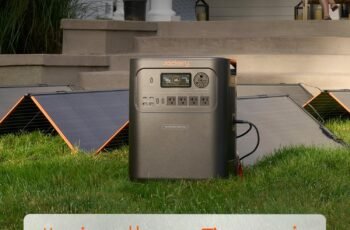
Beyond its capacity, the Dyness PPS1800 offers flexible charging, useful device connections, and built-in safeguards. Charging options include AC, solar, and 12V or 24V vehicle input; AC charging reaches 80% in about 50 minutes. Solar input supports up to 1,200W through the XT60 port, with panels sold separately. We can connect devices through three AC outlets, two USB-C ports, two USB-A ports, and a car outlet; one USB-C port delivers up to 100W. Its Bluetooth app controls let us monitor power and battery status, adjust charging limits, and set schedules nearby. A LiFePO4 battery management system helps guard against electrical and thermal faults.
Pros and Cons
We’ll weigh the PPS1800’s 1,536Wh capacity, fast charging, and long-life LiFePO4 battery against its 38.6-pound weight and lack of Wi-Fi access. We’ll also consider its broad output options and UPS capability alongside limits such as the 1,500W UPS load ceiling. This comparison will help you judge whether its strengths outweigh its practical drawbacks.
Pros
The Dyness PPS1800’s main strengths are its practical 1,536Wh capacity, 1,800W continuous output, and flexible charging options. That combination lets us power common appliances during outages and support devices on trips. AC, solar, and vehicle charging add useful flexibility, while combined AC and solar input can reach 80% in about 43 minutes. We also get three AC outlets, USB-C and USB-A ports, and a car outlet, including 100W USB-C charging for compatible laptops. Its durable battery is rated for over 4,000 cycles, and built-in protections monitor key operating conditions. Quiet operation, app controls, and sub-10ms UPS switching further broaden its usefulness.
Cons
Those strengths come with a few limitations to weigh. At 38.6 pounds, the PPS1800 isn’t easy to carry far, despite its dual handles. We should treat its size and weight as Portability tradeoffs: suitable for vehicle-based trips or moving around a home, but less convenient for long walks or frequent lifting. The two-year Limited warranty also offers less coverage than some buyers may expect for a power station built around a long-life LiFePO4 battery. Solar panels aren’t included, adding to the cost of solar charging. Finally, Bluetooth monitoring works only nearby; we can’t check status or adjust settings remotely over Wi-Fi.
Concluding thoughts
For home backup, camping, or RV use, the Dyness PPS1800 offers a practical balance of capacity, output, and charging flexibility: its 1,536Wh LiFePO4 battery and 1,800W continuous output can run many everyday appliances, while AC, solar, and vehicle inputs suit different settings. We also value its 3,600W surge capacity, fast AC charging, varied ports, and sub-10ms UPS switching for compatible loads. The app supports nearby monitoring, though it lacks remote internet access. At 38.6 pounds, it’s portable but not lightweight. With over 4,000 rated cycles, protective battery management, and a two-year warranty, we see solid everyday usability and potential long term value.
Frequently Asked Questions
Can the PPS1800 Power Devices While It Is Charging?
Yes, we can use the PPS1800 for simultaneous operation while charging, commonly called Pass through charging. It supports AC, solar, or vehicle input, but we should stay within its output limits and follow the manual.
Are Solar Panels Included With the PPS1800?
No—the PPS1800 doesn’t include solar panels. Think of it as a sun-ready vessel: we can connect compatible panels through its XT60 input, but you’ll need a separate panel purchase to harness sunlight.
Can the PPS1800 Provide Internet-Based Remote Monitoring?
No, we can’t monitor the PPS1800 over the internet. Its Remote App uses nearby Bluetooth, not Wi Fi Connectivity, so you must stay within Bluetooth range to check battery levels, power use, and settings.
Is the PPS1800 Suitable for Grid-Tied Operation?
No—the PPS1800 isn’t designed for grid-tied operation. Think of it as an island, not a bridge: we shouldn’t connect it to utility interconnection systems. Its Grid tied compatibility is absent, so use it independently.
What Accessories Come With the PPS1800?
We get an AC charging cable, port-to-XT60 cable, cigarette lighter output, and user manual with the PPS1800. For accessory compatibility, we should note solar panels aren’t included; the XT60 input supports compatible panels, up to 1,200W.
Conclusion
The Dyness PPS1800 is a capable home backup and camping power station, pairing 1,536Wh of capacity with 1,800W continuous output and a 3,600W surge rating. We value its fast AC charging, flexible input options, quiet operation, app controls, and long-life LiFePO4 battery. It can keep essential appliances running like a steady anchor during outages. However, its 38.6-pound weight reduces portability, and solar panels cost extra. We’d choose it for dependable power, not frequent carrying.